
Ask an AI tool a question and you will get an answer. Every time. It will be confident, nicely formatted, and every so often completely made up.
In a chat window, that's annoying. In your books, it's expensive. A wrong match in a bank reconciliation doesn't look wrong. It looks done. The deposit is ticked off, the invoice is closed, and the mistake sits there quietly until your auditor finds it, or until a vendor calls to ask why the bill you marked as paid never got paid.
Finance leaders already know this. In a Wakefield Research survey of 100 CFOs at midsize US companies, only 14% said they completely trust AI to deliver accurate accounting data on its own. 86% said their team had already run into inaccurate or made up data from an AI tool.
So when we designed the AI layer at Greenloom, the first question wasn't how to make it match more. It was what it should do when it isn't sure. The answer we landed on was simple: say so.
Why do AI tools guess instead of saying "I don't know"?
Because most AI models are trained and scored like students taking a multiple choice test. A guess might earn points. A blank answer never does. So the model learns that sounding sure pays better than being honest. OpenAI researchers made exactly this argument in a 2025 paper, and it explains a lot of what goes wrong when AI meets accounting.
The paper puts it plainly: language models hallucinate "because the training and evaluation procedures reward guessing over acknowledging uncertainty." Their example is a birthday. Guess a random date and you have a 1 in 365 chance of being right. Say "I don't know" and you are guaranteed zero. On the scoreboard, the guesser wins.
That's fine for trivia night. It's a terrible habit for software that closes invoices. A tool that guesses its way to being right 95% of the time still gets 1 match in 20 wrong, and nothing on the screen tells you which one.
What are the three answers our AI can give?
Most matching tools have two outcomes: matched or unmatched. Ours has three. This is the match. This can't be the match. Or I don't know, and here's why. That third answer is the one most systems are missing, and it's the one that keeps guesses out of your books.
Without it, every unsure case gets forced into one of the other two. Either the system guesses and you get confident wrong matches, or it gives up and your team does the work the software was supposed to do. Neither one is what you paid for.
If you're new to how matching works in the first place, our guide on what reconciliation is covers the basics.
Doesn't a careful AI just match less?
Only if you build it badly. The easy way to make AI "safe" is to bury it in rules until it barely matches anything. We decided against that. Our AI is supposed to match the way a good accountant would, including the cases where the names, references and amounts are messy.
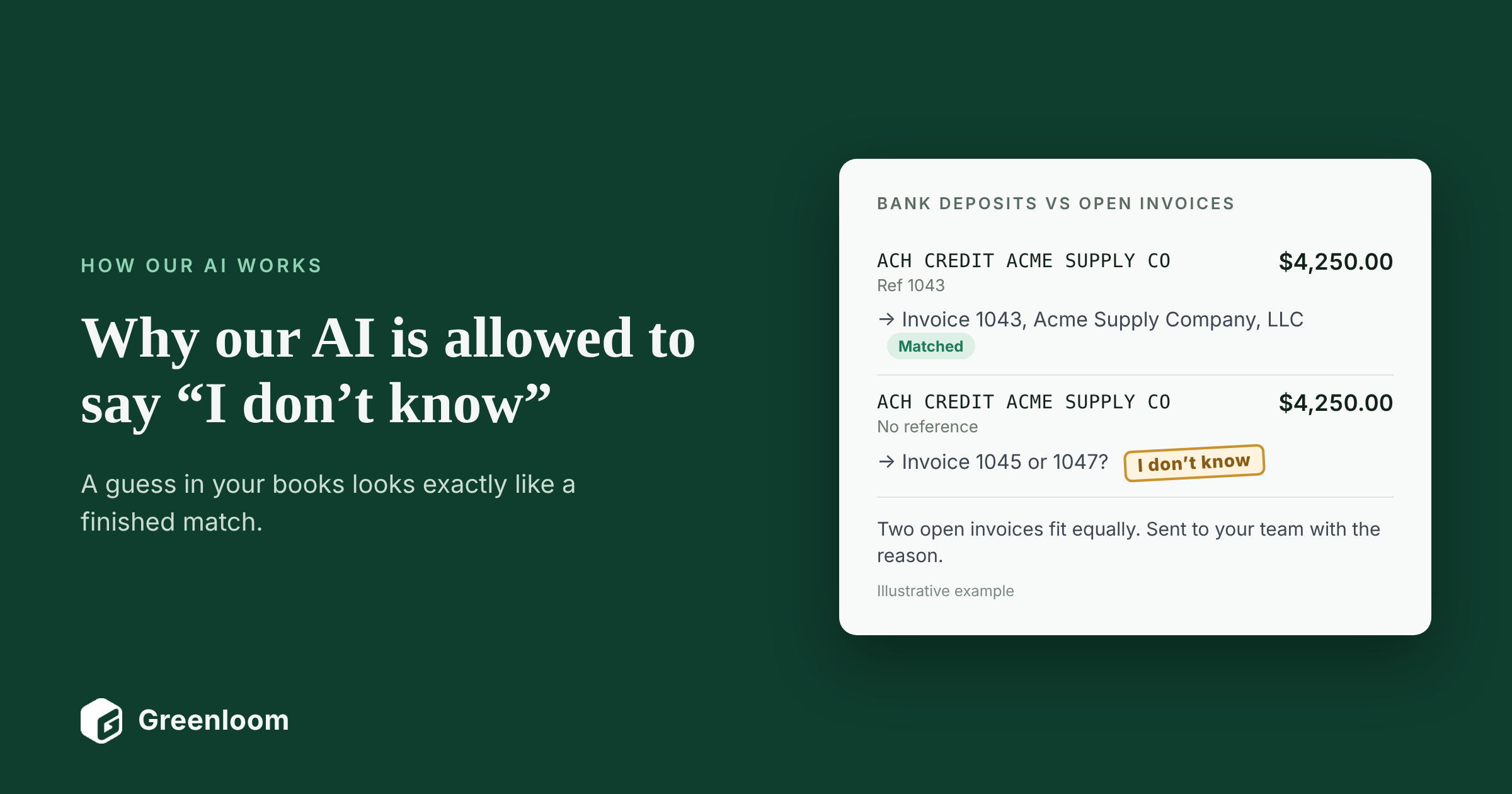
Picture a deposit on your bank statement that reads ACH CREDIT ACME SUPPLY CO, and an open invoice in QuickBooks for Acme Supply Company, LLC. Anyone on your team matches those in about two seconds. Same customer. The bank shortened the name and dropped the LLC, because bank statements are written by people who seem to get charged by the letter.
If our AI refused that match because the text isn't identical, it wouldn't be careful. It would be useless, and you'd be paying for software that hands the easy cases straight back to you.
So the AI gets to use judgment the way a person does. A shortened company name. A reference number the bank cut off halfway. A deposit that's short by exactly the Stripe fee. (If that last one sounds familiar, our post on what payment gateways really charge is for you.)
Finding the match is the AI's job. Deciding whether that match gets into your books is not.
What decides if an AI match is allowed into your books?
A separate checker that sits between the AI and your ledger. It doesn't care how confident the AI sounds or how good its explanation reads. It asks one question: does anything in the data contradict this match? If yes, the match is refused. If no, it goes through.
Here's what counts as a contradiction:
- The amounts don't agree, even after known fees are taken into account.
- There's an equally good rival. Two open invoices for $4,250.00 from the same customer, and nothing in the data to tell them apart.
- A reference points somewhere else. The payment mentions invoice 1043, and the AI wants to match it to invoice 1047.
- The record is already taken. That invoice was already matched to a different payment.
- The direction or currency is wrong. Money coming in can't pay a bill you owe, and a Canadian dollar payment doesn't quietly settle a US dollar invoice.
Notice what's not on that list: "the AI couldn't prove it beyond any doubt." If a match makes sense and nothing in the data argues against it, it goes through. We didn't build this to keep our own checker happy. We built it to reconcile your books.
But when the data does argue, the match stops. No amount of confident explanation gets it past the checker. The AI is allowed to be smart. It is not allowed to be creative with your cash.
What happens to a transaction the AI can't match?
It goes to a short list for your team, with a plain reason attached. Not just "unmatched," but why. Two invoices fit equally. The deposit is $37.50 short with nothing to explain it. The reference belongs to a different customer. Your team answers one specific question instead of starting from scratch.
A bare "unmatched" is almost as unhelpful as a wrong match. It's the accounting version of "Something went wrong. Please try again."
We're also strict about one difference. "We looked, and there's nothing in your books for this" and "we didn't get to this one" are two different statements. If a transaction wasn't investigated, we say exactly that. We never dress it up as a finding.
Does the same rule apply to fees and bank holidays?
Yes. Reconciliation depends on facts like card fee rates, bank holidays and how many days a payout takes to land. Every fact our engine uses has a source behind it. When a fact isn't verified yet, the engine doesn't fill in a number that's probably right. It refuses that case and says which fact is missing.
Here's a small example. The Federal Reserve is closed on Columbus Day, so ACH payments don't settle that Monday. An engine that doesn't know that will go looking for a deposit on a day when no deposits move, and then get creative about where it went.
That's why we don't guess facts. A guessed rate doesn't cause one wrong match. It causes every match that depends on it to be wrong in the same way, all at once, with total confidence. One bad assumption, copied a few thousand times.
What if a wrong match gets through anyway?
No checker catches everything, so it isn't our only layer. Every match is labeled with how it was made. Every match can be undone cleanly. Any kind of match that starts going wrong switches itself off. And we test the system every day against data where we already know the right answers.
The labels mean you can always see whether a match came from a rule or from the AI. Undo means a mistake costs you a click, not an afternoon of journal entries. The automatic switch off means one bad pattern gets stopped while everything else keeps working. And the daily test means a problem should show up on our side before it shows up in your close.
Why does this matter to a CFO?
Because you don't need an AI that is always confident. You need one whose confidence means something. In the same Wakefield survey, 97% of CFOs said human oversight is critical when AI touches accounting data. An AI that says "I don't know" is what makes that oversight practical.
When our system says matched, it's because the evidence supports it and nothing in your data says otherwise. When it says "I don't know," it's pointing your team at exactly the place their judgment is needed, and telling them why.
Confidence is easy to fake. Ask anyone who has built IKEA furniture without the instructions. What's hard is building something that knows the difference between "I'm sure" and "I think so," and tells you which one it is.
How does Greenloom reconcile your bank against your books?
Greenloom connects your bank statements to your accounting system, like QuickBooks Online, and matches every transaction. Rules handle the clear cases. The AI works through what's left. The checker stands between both of them and your books. Anything nobody can settle comes to your team with the reason attached.
You end the month with a clear record: what matched, how it matched, what's waiting and why. That's what your team needs to close, and it's what your auditor will ask for anyway.
If you're comparing tools, our roundup of AI tools for accountants shows where Greenloom fits next to close and audit software.
Want to see it on your own numbers? Bring one month of bank statements and your QuickBooks books, and we'll show you what matches, what doesn't, and why. Book a demo.
Frequently asked questions
Can AI do bank reconciliation accurately? It can, if something checks its work. AI is good at matching the messy transactions that simple rules miss, like shortened names and partial references. On its own, though, it tends to guess when it's unsure. Look for a tool that checks every AI match against your data and tells you when it can't decide.
Why does AI make up answers in accounting? Most AI models are trained and scored in a way that rewards guessing over admitting uncertainty. OpenAI researchers described this in a 2025 paper. In accounting, that habit shows up as confident matches, numbers or explanations that aren't supported by your data.
What happens to bank transactions the AI can't match? In Greenloom, they go to a short review list for your team with a plain reason attached, for example two invoices that fit equally or a deposit that's short with no explanation. Transactions that weren't investigated are marked that way, never as missing from your books.
How is AI matching different from QuickBooks bank rules? Bank rules follow conditions you set up in advance, like a description that contains certain words and an amount. They work well for repeat transactions and miss everything else. AI matching reads each transaction the way a person would, so it can handle names, references and amounts that don't fit a rule.
Will AI replace accountants? No. It takes the repetitive matching off their plate and hands them the cases that actually need judgment, with the reasons already written down. In a 2026 survey of US CFOs, 97% said human oversight is critical when AI is used in accounting.
Can I undo a match the AI made? Yes. In Greenloom every match is labeled with how it was made, and any match can be undone cleanly, without manual journal entries to clean up afterward.
Sources
- Adam Tauman Kalai, Ofir Nachum, Santosh S. Vempala and Edwin Zhang, Why Language Models Hallucinate, arXiv, September 2025
- CFO Dive, CFOs insist on human oversight for AI in accounting, study finds, January 28, 2026 (survey of 100 CFOs at midsize US companies by Wakefield Research, commissioned by Maximor)
- Federal Reserve Financial Services, Holiday schedules
Updated


Comments
Join the conversation and share your thoughts with the community.
Community
Be the first to share your perspective.