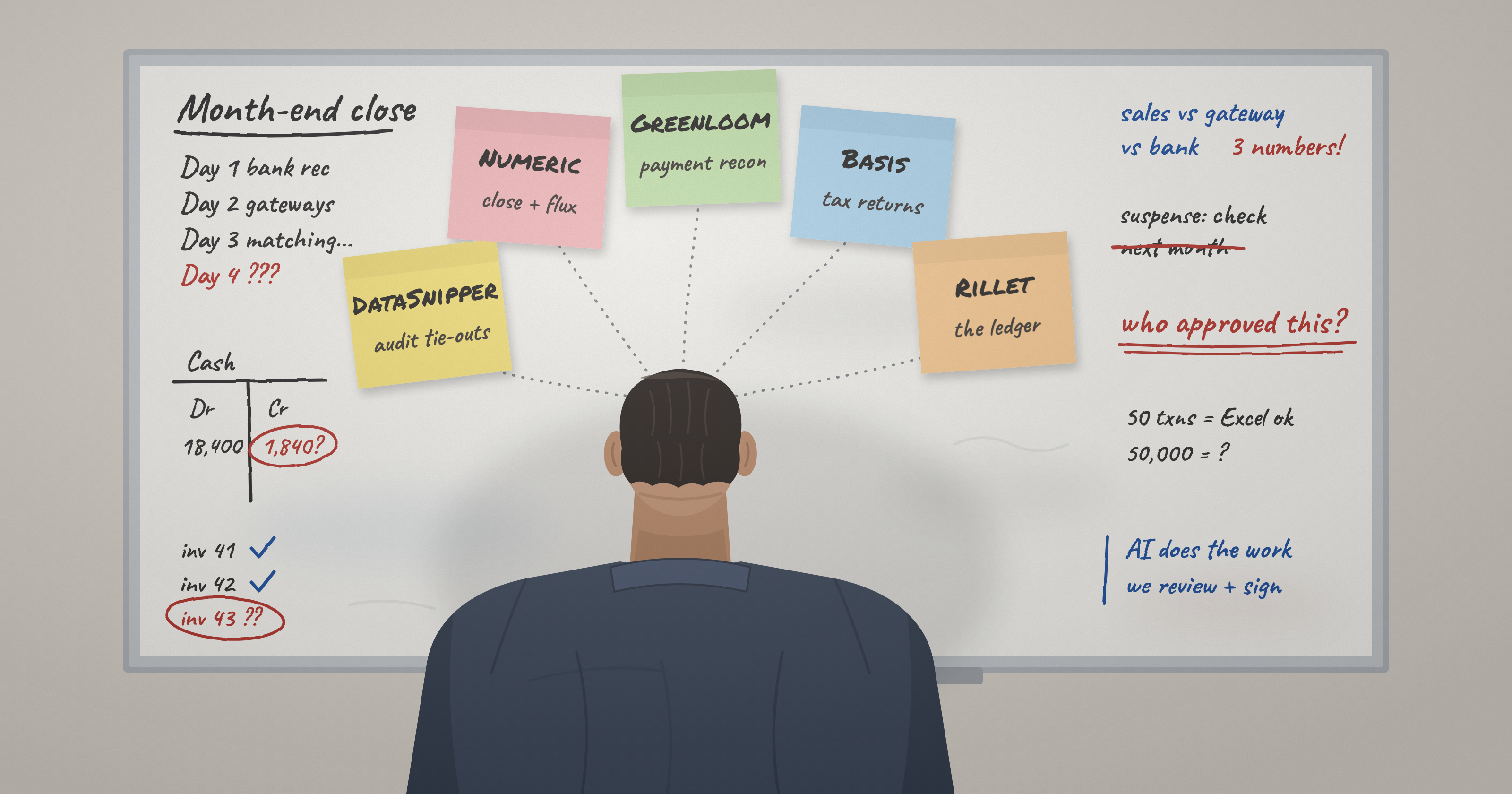
Most lists of AI tools for accountants start with ChatGPT.
It can explain IFRS 16 lease accounting in plain English.
It can't touch your ledger.
The five tools below work differently. They're AI agents. You don't ask them questions. You give them a job, like "reconcile these payouts" or "test these revenue samples," and they do it.
Then someone on your team reviews the work and signs off.
The most useful AI tools for accountants in 2026 are agents that run a full task and hand back finished work for review. DataSnipper handles audit evidence, Numeric runs the close and flux, Greenloom reconciles high-volume payment payouts, Basis runs firm workflows like tax returns, and Rillet replaces the ledger itself.
Disclosure: Greenloom is built by our team at Greenmint Labs. It's on this list because high-volume reconciliation is a gap the other four don't cover, and it gets the same "catch" section as everyone else.
Tool | Best For | Fits | Pricing |
|---|---|---|---|
Data Snipper | Audit testing, tie-outs, disclosure | Audit firms, internal audit | Quote-based |
Numeric | Month-end close and flux commentary | Controllers on NetSuite, QuickBooks, Xero, Sage Intacct | Published entry pricing |
Greenloom | Payment gateway and bank reconciliation at volume | Businesses collecting through several channels | 20-day free trial |
Basis | Tax, audit and client accounting workflows | Accounting firms | Contact sales |
Rillet | AI-native general ledger | SaaS and service companies | Contact sales |
1. DataSnipper: the AI tool auditors already use for tie-outs
DataSnipper is an Excel add-in that links every number in a workpaper to the exact spot in the source document. Since October 2025 its agents can run whole testing procedures from a plain-language instruction, and its new Alwin platform, launched 22 September 2026, runs multi-step audit procedures end to end.
You have a sample of 60 invoices. You open each PDF, find the amount, match it to the ledger, put a tickmark and move to the next one. Sixty times. Then the reviewer asks where number 43 came from.
DataSnipper was founded in Amsterdam in 2017 to fix exactly that. Click a cell and it shows you where the number sits in the document. That was the original product.
On 1 October 2025, together with Microsoft, DataSnipper launched Excel Agents and Disclosure Agents. With Excel Agents you give the objective, for example "test these revenue samples against the invoices," and the agent extracts, matches, flags exceptions and builds the workpaper.
Disclosure Agents check financial statement disclosures against IFRS and GAAP checklists, one of the slowest parts of any audit.
Then on 22 September 2026 it launched Alwin. Alwin pulls hundreds of documents from your systems and runs a full procedure, from evidence collection to the finished workpaper. Every output is tied back to a snip in the source, so the reviewer can still trace each conclusion.
DataSnipper says it's used by over 600,000 audit and finance professionals in 175 countries, including all of the Big Four. If you work in audit, this is already the standard.
The catch: Pricing is by quote, and the product is built around Excel. For a solo practitioner it's more than you need. For an audit team doing heavy sample testing every season, it pays for itself.
Website: datasnipper.com
2. Numeric: AI for month-end close and flux analysis
Numeric is a close management platform that connects to NetSuite, QuickBooks, Xero and Sage Intacct. Its two strongest features are cash matching, which Numeric says auto-matches over 90% of transactions, and a flux agent that reads the transactions under a variance and drafts the explanation for you to edit.
The close takes the first week or two of every month. Staff export transactions and reconcile by hand. The manager keeps asking if the bank rec is done.
Then comes the part every controller dreads: flux commentary. Why did travel go up 38% on last month? You write it account by account, from a blank page, every month.
Numeric pulls your trial balance live from the ERP. Its flux agent doesn't stop at "travel is up 38%." It looks at the entries underneath and drafts the reason, so you get "travel rose mainly because the sales team took three client trips" instead of a number with no story.
The accountant edits and approves. The explanation, the account and the reviewer's sign-off sit in one place, which is where the auditor will look.
On cash, Numeric reported auto-match rates above 90% for its cash management product when it raised a $51 million Series B led by IVP in November 2025. It also publishes its entry pricing, which is rare in a category where most vendors make you book a demo first.
The catch: Numeric is a close platform, and bank rec is one feature inside it. That works if you have a few bank accounts and normal volumes.
If you collect money through five payment channels and process thousands of transactions a day, bank rec isn't a feature for you. It's a full-time job.
That's tool 3.
Website: numeric.io
3. Greenloom: AI reconciliation for high-volume payment gateways
Greenloom is AI reconciliation software built for businesses with more than one income source. It matches your order data, payment gateway settlement reports and bank statements down to each transaction inside each payout, explains every gap in plain language, and holds exceptions for your team to approve before anything posts.
Quick question before this one. How many days did your team spend on reconciliation last month?
If the answer is one, skip ahead. If it's four, or "it never really finishes," read this section.
Say you run an online store, a subscription business, a lending company or a chain of clinics. Money comes in through card gateways, wallets, bank transfers and cash-on-delivery partners.
None of them pay you one clean amount per sale. The gateway bundles two or three days of sales into one payout. It takes its fee, adds tax on that fee, holds back refunds and chargebacks, and lands the rest in your bank as a single credit.
So your sales data says one number, the settlement report says another, and the bank says a third.
You know what happens next. Someone downloads all three and opens Excel. VLOOKUP, filter, pivot, hundreds of thousands of rows.
By day three most of it matches, and there's still a gap nobody can explain. It goes into suspense, "to be checked next month." Next month a new one lands on top of it.
When volume doubles, the process doesn't change. You hire another person to run the same VLOOKUPs.
Here's the uncomfortable part. That unexplained gap is often real money.
A fee charged above your contracted rate. A refund processed twice. A payout that never arrived.
It sits there because nobody has time to chase it. We broke down where these losses hide in our guide to auditing payment gateway fees.
How does Greenloom reconcile a payout?
1. You connect the data.
Order or transaction data, each gateway's settlement reports, and your bank statements.
2. The agent matches every line.
It ties each transaction inside each payout to the order behind it, then ties the payout to the bank credit.
3. It checks the deductions.
Each fee is tested against the rate you agreed for that card or channel.
4. It explains what doesn't fit.
Instead of a red cell, you get a reason. For example: "this $1,840 gap is the gateway fee, tax on that fee, and one refund deducted from the next payout."
5. Your team approves the exceptions.
Nothing posts to your ERP until someone approves it, and every decision is logged for audit.
So the job changes. Your team stops finding problems and starts fixing them. Days of matching become a short list of exceptions.
The simple test: at 50 transactions a month, Excel works. At 50,000, it doesn't. You're just paying people to pretend it does.
The catch: Greenloom is a specialist. It won't run your close or write your flux commentary. It only does reconciliation. If your volumes are small, you don't need it yet.
Try it on your own settlement files. Greenloom comes with a 20-day free trial, so you can run last month's payouts through it and see what matches and what doesn't.
4. Basis: AI agents that run full accounting firm workflows
Basis builds long-running AI agents for accounting firms that work through tax, audit and client accounting tasks for hours, then hand back a finished deliverable for review. It says it completed the first end-to-end Form 1065 partnership return by an AI agent, and it raised $100 million at a $1.15 billion valuation in February 2026.
A US partnership tax return, Form 1065, is one of the most labour-heavy filings a firm prepares. Basis says its agent completed one end to end on its own, with no human keying in numbers.
Basis was founded in 2023. On 24 February 2026 it raised a $100 million Series B at a $1.15 billion valuation. Accel led the round, with GV, former Goldman Sachs CEO Lloyd Blankfein and existing investor Khosla Ventures.
That's a lot of money for accounting software. The reason is how the agents work.
Most tools do one task. Basis builds what it calls "long-horizon" agents, which work through a complex workflow in the background and return the finished file for a human to review.
Think of a junior who gets a client file on Monday and hands you a draft return on Wednesday. Basis is trying to be that junior, minus the months of training.
Basis says it's used by about 30% of the top 25 US accounting firms and 20% of the top 150.
Why it matters outside the US: fewer people are entering accounting and clients want more. Firms in New York, Pune and Dubai face the same shortage.
The catch: It's built around US workflows and started with large firms. In August 2026 it began rolling out a version for small firms, so check what's available for your practice and your country before planning around it.
Website: getbasis.ai
5. Rillet: the AI-native ERP that replaces your ledger
Rillet is an AI-native ERP, a general ledger designed so AI agents can post entries, reconcile and run the close on live books, with human approval and a full audit trail. It raised $100 million at a $1 billion valuation in August 2026 and says it has more than 600 customers.
This one is the biggest shift on the list.
Every tool so far sits on top of your ERP. Rillet asks a different question: what if the ledger itself was built for AI agents from day one?
It was started by Nicolas Kopp, who previously led N26 in the US and ran into the limits of legacy ledgers while scaling it. Rillet's agents work on the books as transactions happen, instead of in a month-end batch. The company calls this a "zero-day close."
On 17 August 2026, Rillet announced a $100 million Series C at a $1 billion valuation, led by ICONIQ with Sequoia and Andreessen Horowitz. Kopp said the round came together in under 48 hours. ICONIQ puts the customer base at more than 600 companies across 60 countries.
Rillet says moving onto it takes about four to six weeks, against months for a traditional ERP.
Two customer examples it shares often: Postscript closes its books in three days, and Windsurf runs its finance function with two people. These are company-supplied figures, so treat them as best cases.
The catch: It's not a full ERP in the old sense. There's no inventory and no manufacturing. It's built mainly for SaaS and service companies.
And "zero-day close" is a product label, not an accounting standard. Your auditor doesn't care what the software calls it.
Website: rillet.com
What do all five AI accounting tools have in common?
Each one follows the same pattern: the AI does the work, and a human reviews the exceptions and signs.
That changes what a good accountant looks like. The skill that matters most is no longer doing the work fast, it's reviewing well and being able to say why an output is wrong.
For 50 years, a good accountant was someone who did the work quickly and without mistakes. Over the next five years, a good accountant will be someone who reviews well.
Someone who can look at what the agent produced and say, "This is wrong, and here's why."
The question auditors will start asking isn't "did you use AI?" It's "who approved this entry, and what did they check?"
Every tool on this list keeps a trail for that reason.
How do you choose the right AI tool for your finance team?
Don't trial all five. Open last month's close, find the single task that ate the most hours, and pick the tool built for that one problem.
Audit testing points to DataSnipper, flux to Numeric, high-volume reconciliation to Greenloom, firm tax workflows to Basis, and a ledger replacement to Rillet.
Trying everything at once is how teams lose six months to demos.
For some of you, the painful task is audit testing. For some, it's flux. For a lot of finance teams, if we're honest, it's the reconciliation sheet that never fully ties.
If that's you, there are two ways to go from here.
You can keep adding people every time volume grows.
Or you can hand the matching to an agent and let your team work only on the exceptions.
See what your payouts are really doing.
Run your own gateway and bank files through Greenloom free for 20 days, or talk it through with our team first.
Start your 20-day free trial
Book a call with our team
Frequently asked questions
What are the best AI tools for accountants in 2026?
It depends on the job. DataSnipper leads for audit evidence and testing, Numeric for month-end close and flux commentary, Greenloom for high-volume payment and bank reconciliation, Basis for accounting firm workflows like tax returns, and Rillet if you want to replace the general ledger.
Start with the task that costs your team the most hours.
Can ChatGPT do bank reconciliation?
Not reliably. ChatGPT can explain reconciliation or help write a formula, but it doesn't connect to your ledger, gateway reports or bank feeds, and it can't keep an audit trail.
Reconciliation at volume needs software that reads the source files, matches line by line and records who approved each exception.
Will AI agents replace accountants?
They're replacing tasks, not the role. The tools on this list all keep a human in the loop to review and approve.
What changes is the work: less data entry and matching, more review, judgement and explaining exceptions.
Firms struggling to hire see agents as extra capacity, not as a cut in headcount.
What's the difference between close software and reconciliation software?
Close software manages the whole month-end: checklists, account reconciliations, flux analysis and sign-offs.
Reconciliation software goes deep on matching, such as tying thousands of gateway transactions to payouts and bank credits.
A business with a few bank accounts can rely on close software. One with high payment volume usually needs both.
Do auditors accept work prepared by AI agents?
Auditors care about evidence and approval, not the tool.
Work prepared by an agent is acceptable when every figure traces back to a source document and a named person reviewed and approved it.
That's why the tools here link outputs to source data and log each decision.
How much do AI accounting tools cost?
Pricing varies widely.
DataSnipper, Basis and Rillet quote on request. Numeric publishes entry pricing. Greenloom offers a 20-day free trial so you can test it on your own data before paying.
Compare cost against the hours the tool removes from your close, not against other software licences.
Sources
DataSnipper, Alwin launch announcement, 22 Sep 2026
DataSnipper, Excel Agents and Disclosure Agents launch with Microsoft, 1 Oct 2025
CPA Practice Advisor, Numeric raises $51M Series B, 20 Nov 2025
Reuters via Yahoo Finance, Basis raises $100 million at $1.15 billion valuation, 24 Feb 2026
Rillet, Series C announcement, 17 Aug 2026
TechCrunch, Rillet raises $100M Series C at $1B valuation, 19 Aug 2026
Rillet, Series B announcement (Postscript and Windsurf examples)
Updated
Comments
Join the conversation and share your thoughts with the community.
Community
Be the first to share your perspective.