
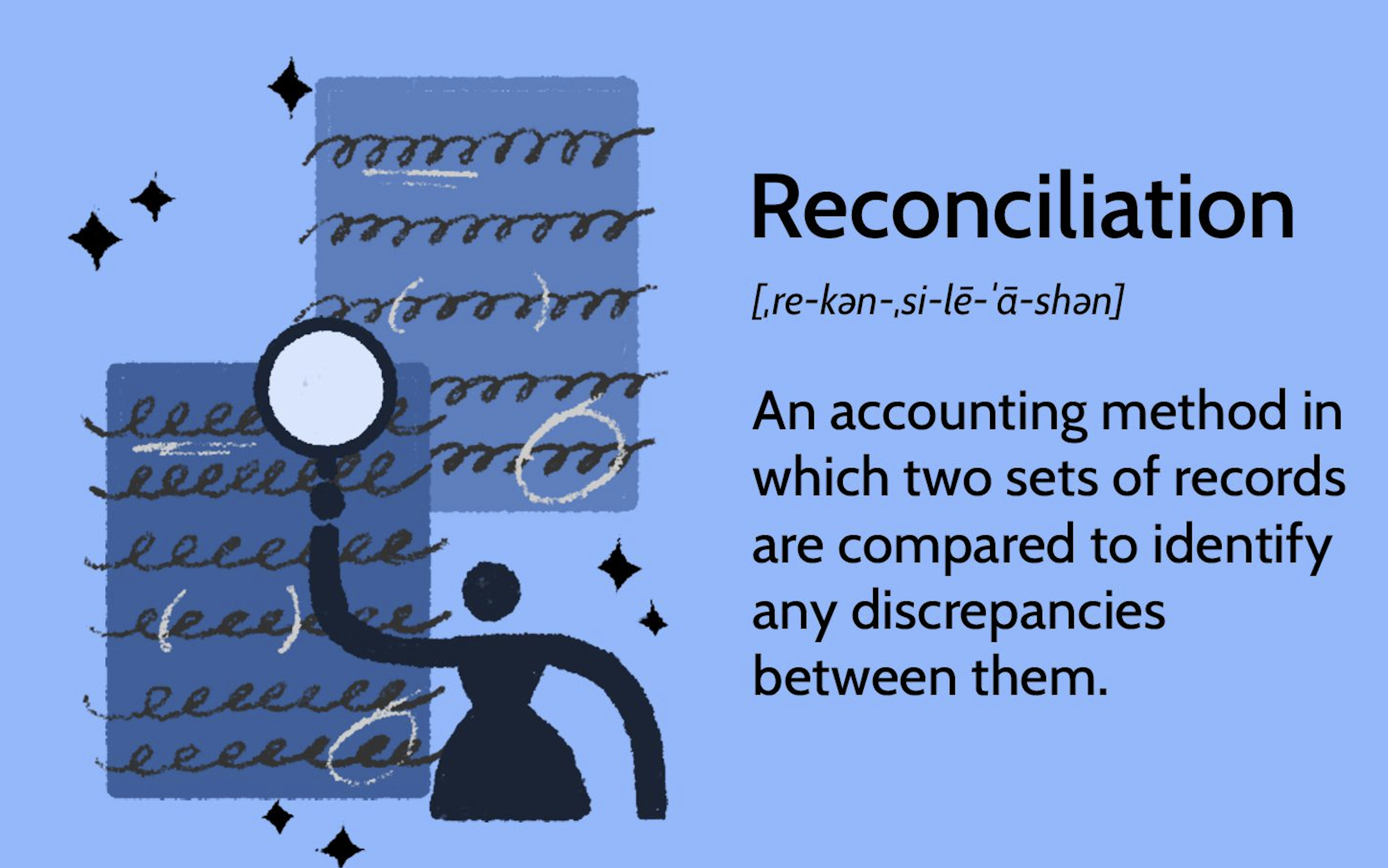
Reconciliation is the process of checking that two separate records of the same money agree. On one side, what your books say happened you sold something for a certain amount on a certain date. On the other, what actually happened to the money a card was charged, a fee was deducted, a payout landed in your bank three days later bundled with four hundred other orders.
When those two records match, your numbers can be trusted. When they don't, something needs explaining before the month can close.
Every finance team does this. Most of them do it in a spreadsheet, and most of them lose evenings to it.
Why do the two records ever disagree?
If a customer paid you SAR 1,000 and SAR 1,000 arrived in your bank account on the same day, reconciliation would take seconds. That almost never happens, for four structural reasons.
Money arrives later than the sale. Payment providers don't transfer funds per transaction. They settle in batches, typically days after the sale. Your revenue is recorded on Monday; the cash shows up on Thursday.
Money arrives smaller than the sale. Processing fees, platform commissions and VAT all come off somewhere between the customer paying and you being paid. The deposit is never the sum of the sales it represents.
Money arrives bundled. One line on your bank statement can represent hundreds of individual orders. Proving which orders are inside that lump sum is most of the work.
Money sometimes goes backwards. Refunds, cancellations and chargebacks reverse transactions that you already recorded and possibly already reconciled often weeks later, landing in a different period entirely.
A worked example
Take a single SAR 1,000 order on a Saudi e-commerce store.
Your books record revenue of SAR 1,000 on the day of the order. The payment gateway deducts a processing fee say 2.5 %, so SAR 975 is what will actually be paid out. But the gateway doesn't pay per order. Three days later it transfers one lump sum of SAR 380,000 covering roughly four hundred orders. One of those customers refunded the day before payout, so their order isn't in the batch at all. VAT sits across all of it and has to be accounted for separately.
Now the finance person's job: take that single SAR 380,000 line on the bank statement and prove which 399 orders it represents, explain why it isn't SAR 400,000, account for the fees, and identify the refund that explains the remaining gap.
Then do it again for the next payout. And the one after that.

What are the main types of Reconciliation?
The word covers several distinct jobs, and finance teams usually run more than one.
Bank reconciliation. Matching your internal cash records against the bank statement. The oldest and most familiar form and the one most accounting software handles reasonably well, provided all your money moves through one account.
Payment gateway or settlement reconciliation. Matching each provider's settlement reports against both your order records and your bank deposits. In Saudi Arabia this often means handling mada, STC Pay, Apple Pay, card rails and BNPL providers like Tabby and Tamara each with its own file format, fee structure and payout schedule.
Marketplace and aggregator reconciliation. If you sell through platforms noon, Talabat & Jahez etc. The platform collects the money, deducts commission and VAT, and remits the rest on its own cycle. You're reconciling against a statement produced by someone else's system.
Intercompany reconciliation. For groups with multiple legal entities, making sure balances between those entities agree with each other before the group accounts consolidate.
Balance sheet reconciliation. Confirming that the balances in your general ledger are supported by real, documented evidence the broadest form, usually done at period end.
Why does reconciliation get harder as a business grows?
The workload doesn't scale with revenue. It scales with combinations.
A business taking payments one way, at low volume, reconciles one settlement file against one ledger. That's a person, a spreadsheet and an afternoon. Annoying, but it works.
Add a second payment provider and you haven't doubled the work you've created a matrix. Every source now has to be checked against every ledger account and every bank deposit, each on a different timing cycle, each with different deductions. Add a marketplace. Add a second legal entity. Add a foreign currency, the loop goes on.
This is why reconciliation quietly stops being viable at a specific point rather than gradually getting worse: somewhere between one money source and three, at volume, the spreadsheet stops being a tool and becomes the bottleneck.
What is an exception?
An exception is any line that didn't match. It is the actual work product of reconciliation everything else is confirmation that things are fine.
Exceptions usually come from a small set of causes: timing differences where the sale and settlement fall in different periods; deductions that weren't itemised, so the gap can't be explained from the statement alone, partial settlements where a batch was split, refunds and chargebacks arriving late, and simple data problems like a duplicated order reference or a mismatched currency conversion.
Each one needs a human decision, and each one takes a person out of their day to chase.

Where does reconciliation sit in the month-end close?
The close is the process of finalising the books for a period. Reconciliation is one of the earliest steps and one of the most common reasons the whole thing runs late because nothing downstream can be trusted until it's done.
Revenue can't be reported confidently if you can't prove what was actually collected. The cash position isn't reliable if deposits aren't tied to sales. Auditors ask for reconciliations as standard evidence, and an unexplained gap becomes a question someone has to answer months later, from memory.
It's also invisible work. Nobody congratulates a finance team for a clean reconciliation. They only notice when it's wrong.
What does good reconciliation look like?
A few things separate a process that holds up from one that merely finishes
It's automated where the matching is mechanical. Comparing amounts, dates and references across files is exactly the kind of work software should do, and humans shouldn't.
Humans handle judgement, not matching. People should spend their time on the genuinely ambiguous cases, not on the 95% that match cleanly.
Every deduction is explained, not just accepted. Knowing the payout was short is not the same as knowing why. The second one is what an auditor asks for.
It works across platforms, not inside one. Any system can reconcile the data it holds. The hard part and where most tools stop is matching across several sources that don't talk to each other.
It's repeatable. The same process, the same evidence trail, every month, reproducible by someone who wasn't there the first time.
Frequently asked questions
How often should reconciliation be done?
Most teams reconcile monthly as part of close. Higher-volume businesses often do it weekly or daily, because the longer you leave it, the more exceptions accumulate and the harder each one is to trace back.
Is reconciliation the same as auditing?
No. Reconciliation is an internal process confirming your own records agree with external evidence. An audit is an independent examination of your financial statements. Clean reconciliations make an audit far easier, but they're separate things.
Can reconciliation be fully automated?
The matching can be largely automated. The exceptions generally can't an unexplained gap needs a person who understands the business to decide what happened. The realistic goal is removing the mechanical work so the judgement work gets proper attention.
What's the difference between bank reconciliation and payment reconciliation?
Bank reconciliation compares your cash records to the bank statement. Payment reconciliation goes a layer deeper matching individual orders to a payment provider's settlement report, and that report to the bank deposit. If you take payments online, the second one is usually where the difficulty lives
Updated

-11.Why%20Odoo's%20Standard%20Bank%20Matching%20Fails%20on%20Saudi%20mada%20Settlements%20(And%20How%20to%20Fix%20It))
Comments
Join the conversation and share your thoughts with the community.
Community
Be the first to share your perspective.