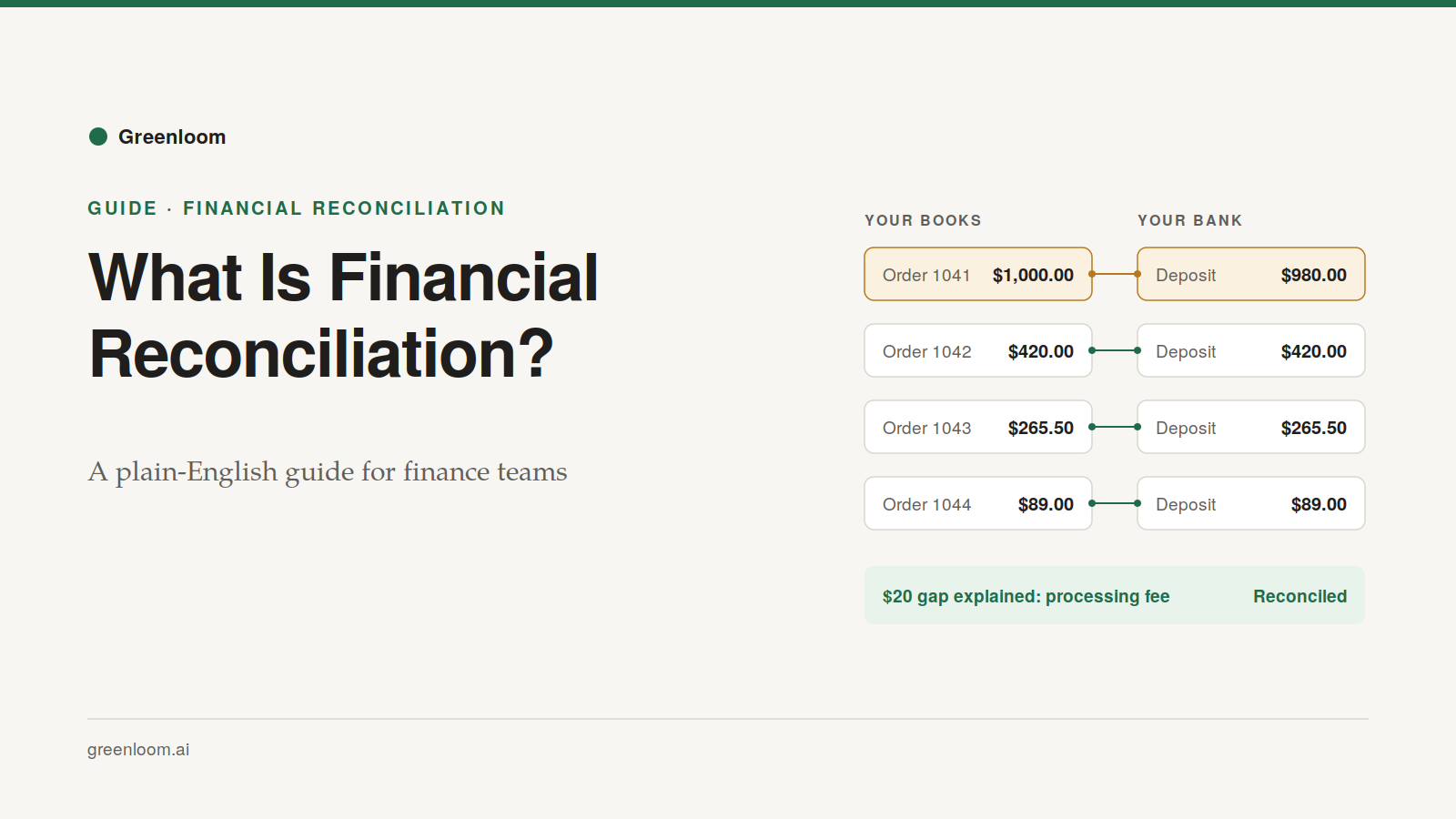
Your sales system says a customer paid $1,000. Your bank says $980 arrived, three days later, bundled into one deposit with 200 other sales. Neither record is wrong. Financial reconciliation is the work of proving that, line by line, and catching the cases where something really is wrong.
This guide explains reconciliation from the ground up: what it is, why the books and the bank almost never agree, the types finance teams run, the step-by-step process, and how AI is changing the hardest part of the job. It is written for controllers, accounting managers and CFOs at US companies that take money through card processors, marketplaces, delivery apps and bank transfers at the same time. It draws on how Greenloom handles this work in practice: the product was built on more than 2,400 real-world mismatches from finance teams.
Financial reconciliation definition
Financial reconciliation is the process of comparing two records of the same money, usually a company's books (the general ledger) and an outside source such as a bank statement or a payment processor's payout report, confirming that each entry has a match, and explaining every difference that remains.
Key takeaways
• Every transaction ends up in one of three places: matched, reconciled with an explanation (a fee, refund or tax), or an exception that a person must investigate.
• Most differences between the books and the bank are legitimate. They come from fees, timing, netting, batching and, less often, real errors.
• Reconciliation is what makes your revenue, cash and profit figures defensible to a board, a lender, an auditor or the IRS.
• The arithmetic of matching is rarely the hard part. The hard part is working out what a payment actually is before it can be matched.
• Automation handles routine matches. The real time savings come from investigating the leftovers, with a named person still approving the result.
In this guide
• What is financial reconciliation?
• Why don't the books and the bank ever agree?
• What are the types of financial reconciliation?
• How does the financial reconciliation process work, step by step?
• What does financial reconciliation look like in a real example?
• Why is financial reconciliation important?
• Who is responsible for reconciliation in a finance team?
• Why is reconciliation harder now than it used to be?
• What are the most common financial reconciliation challenges?
• What is the difference between manual, automated and AI reconciliation?
• Do you need reconciliation software if you already have an ERP?
• How do you choose reconciliation software?
• What are the best practices for financial reconciliation?
• How does Greenloom help with financial reconciliation?
• What do common reconciliation terms mean?
• Frequently asked questions about financial reconciliation
• Sources
What is financial reconciliation?
Financial reconciliation is the accounting process of comparing two independent records of the same money and explaining every difference between them. The goal is simple: prove that what your books say happened is what actually happened. You will also hear it called reconciliation in accounting, or account reconciliation, although account reconciliation usually means checking one balance sheet account at a time.
Every business keeps two kinds of records:
• The books (the ledger). Your own record of what you earned and spent, kept in an accounting system or ERP such as QuickBooks, NetSuite, Microsoft Dynamics, SAP or Oracle. It is updated when you make a sale, raise an invoice or pay a bill.
• The outside record. A record kept by someone else: your bank statement, a Stripe payout reconciliation report, a PayPal settlement file, an Amazon or DoorDash payout, a supplier statement.
Both describe the same money. On any given day, they almost never agree. That is normal, not a mistake. Reconciliation is how you prove the gap is normal and find the part that is not.
What are the three outcomes of reconciliation?
Every transaction you reconcile ends in one of three states:
Outcome | What it means | What happens next |
Matched | The books entry and the outside entry clearly correspond. | Nothing. It is done. |
Reconciled with an explanation | The amounts differ, but the difference has a known, supported reason: a processing fee, a commission, a refund, a tax. | The reason is recorded and the records are accepted as agreeing. |
Exception | The amounts differ and nobody can yet say why. | A person investigates. This is where most of the time goes. |
Is matching the same as reconciliation?
No. Matching is one step inside reconciliation: pairing an entry in one record with its partner in the other. Reconciliation is the whole job: matching, investigating what did not match, explaining or correcting the difference, and getting a named person to sign off. A spreadsheet VLOOKUP can match. It cannot reconcile.
Why don't the books and the bank ever agree?
The books and the bank disagree for five reasons. Four of them are normal business. Only one is a real problem, and reconciliation exists to find it.
Reason | What happens in practice | Example |
Fees | The payment provider keeps a cut before paying you. Your books recorded the full sale. | A customer pays $1,000 by card. The processor keeps about 3% and deposits $970. |
Timing | The sale and the cash land on different days, sometimes in different months. | A sale on March 30 settles on April 2. At month end, the cash is "missing." |
Netting | A refund or chargeback is deducted from a later payout that covers unrelated sales. | Tuesday's payout is $400 short because of a refund for an order from three weeks ago. |
Batching | The provider bundles hundreds of sales into one deposit. No single sale matches it. | One $48,210.55 deposit covers 612 orders, minus fees and two refunds. |
Errors | Something was recorded twice, at the wrong amount, in the wrong account, or not at all. | A supplier invoice was paid twice. A sale was posted to the wrong customer. |
Payment providers document this behavior themselves. Stripe explains that funds move from a pending to an available balance on a settlement schedule, and that refunds, disputes and fees are deducted from the same balance before a payout reaches your bank. Settlement timing varies by country and payment method. Stripe's payouts guide gives the example of a daily payout that covers sales captured three business days earlier.
The practical lesson: a difference is not the same as an error. Treating every difference as a mistake buries the team in false alarms. Ignoring differences lets real errors and fraud slip through. Good reconciliation sorts one from the other, with evidence.
What are the types of financial reconciliation?
The main types of financial reconciliation are bank, payment (settlement), cash, accounts receivable, accounts payable, credit card, intercompany and balance sheet reconciliation. The logic is always the same: compare two records and explain the gap. Only the two records change.
Type | What is compared | Typical frequency | Why it matters |
Bank reconciliation | Cash in the general ledger vs. the bank statement | Daily to monthly | Confirms the cash you report actually exists. |
Payment or settlement reconciliation | Sales recorded vs. what Stripe, PayPal, Adyen, Square, Shopify Payments or a marketplace actually paid out | Daily | Finds fees, refunds, chargebacks and short payouts hidden inside net deposits. |
Cash reconciliation | All cash in and out across every account and payment channel vs. the books | Daily to weekly | Gives treasury a true cash position across banks and processors. |
Accounts receivable (AR) reconciliation | Invoices raised vs. customer payments received | Weekly to monthly | Applies cash to the right invoice and keeps days sales outstanding (DSO) honest. |
Accounts payable (AP) reconciliation | Supplier bills vs. payments made and vendor statements | Monthly | Catches duplicate payments, missed invoices and vendor fraud. |
Credit card reconciliation | Corporate card statements vs. expense records and receipts | Monthly | Stops personal or unapproved spend reaching the books. |
Intercompany reconciliation | Transactions between entities in the same group | Monthly | Both sides must agree before group results are consolidated. |
General ledger and balance sheet reconciliation | Each balance sheet account vs. the evidence that supports it | Monthly to quarterly | The final check before financial statements are signed off. |
Which type causes the most work today?
For companies selling online, in stores or through delivery apps, payment and settlement reconciliation has become the heaviest load. A bank reconciliation can be clean while the payment side is a mess, because the deposit matches the bank line but nobody has proven what is inside it. That is the gap this guide focuses on, and the gap Greenloom was built for.
How do you do a bank reconciliation?
A bank reconciliation brings the bank balance and the book balance to the same adjusted figure.
1. Start with the bank statement's ending balance. Add deposits in transit (recorded in your books but not yet on the statement). Subtract outstanding checks (written but not yet cleared). Correct any bank errors.
2. Start with the ending cash balance in your books. Add amounts the bank collected that you haven't recorded, such as interest. Subtract bank fees, returned (NSF) checks and other charges you haven't recorded. Correct any book errors.
3. Compare the two adjusted balances. They should be equal. If they are not, something is still unexplained.
4. Post journal entries for the book-side adjustments, so your ledger reflects the fees, interest and corrections you found.
How does the financial reconciliation process work, step by step?
A sound reconciliation follows eight steps: set the scope, gather both records, standardize the data, match, investigate, resolve, review, and keep the audit trail. Here is what each one involves.
1. Set the scope and the cutoff. Pick the account, the period and the cutoff date. Nothing posted after cutoff belongs to the period being closed.
2. Gather both records. Export the ledger side from your ERP or accounting system. Pull the outside side: bank statements, processor settlement reports, marketplace payout files, supplier statements.
3. Standardize the data. Put dates, amounts, currencies and references into one consistent format. A Stripe payout ID, a bank memo line and an invoice number rarely look alike until you do.
4. Match what can be matched. Pair entries by rule: one-to-one (one invoice, one payment), one-to-many (one deposit, many sales) and many-to-many (batched payments across periods). Allow a small tolerance for rounding.
5. Investigate what did not match. For each leftover, ask what could explain the gap: a fee, a commission, a refund, a chargeback, a tax, a timing difference, or a genuine error.
6. Resolve or escalate. If the evidence supports an explanation, record it. If a correction is needed, post an adjusting journal entry. If nobody can explain it yet, keep it open as an exception with an owner.
7. Review and sign off. A second person reviews the work. The preparer and the approver are named.
8. Keep the audit trail. Save what matched, what was explained and on what evidence, what is still open, and who approved it.
Steps 1 to 4 are mechanical, and most tools now handle them well. Steps 5 and 6 are where the hours go. That is where a team has to work out what a payment actually is.
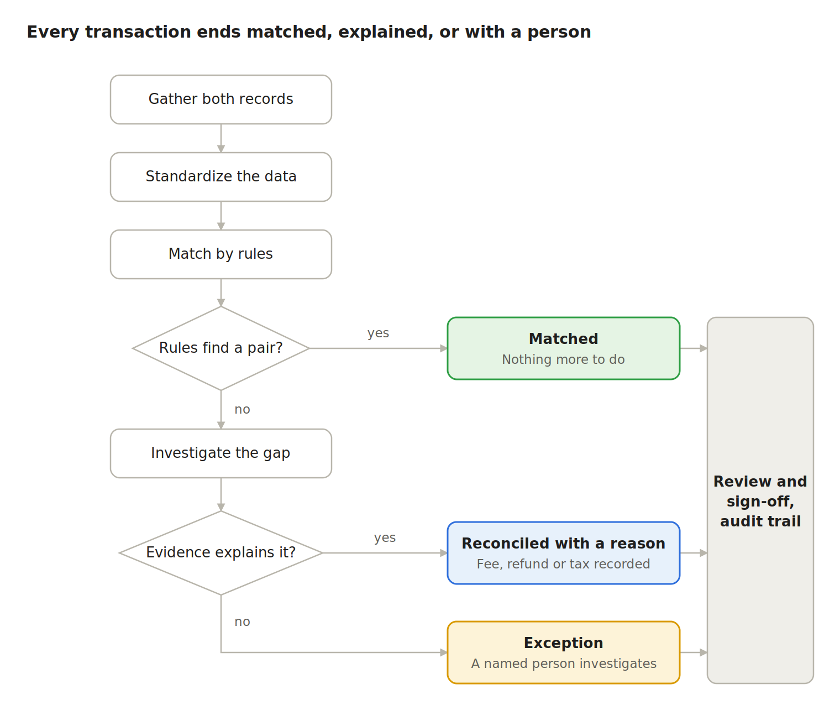
Rules clear the easy pairs. Everything else is investigated, and only what the evidence cannot explain reaches a person
What does financial reconciliation look like in a real example?
Here is one day of trading at a US direct-to-consumer brand that sells through its own Shopify store, PayPal and Amazon. The figures are illustrative, but the pattern is the one finance teams see every day.
Channel | Sales recorded in the books (Mar 14) | Deposit received | Date it lands | Why the amounts differ |
Shopify Payments | $14,000.00 | $13,560.00 | Mar 17 | $440 in card processing fees |
PayPal | $6,000.00 | $5,640.00 | Mar 15 | $210 in fees, plus a $150 refund for a February order |
Amazon | $5,000.00 | $4,100.00 | Mar 28 | $750 in referral fees, plus a $150 return from an earlier order |
Total | $25,000.00 | $23,300.00 | Three different days | $1,700 to explain |
One day of sales became three deposits on three dates, and not one of them equals a number in the books. Two contain deductions for orders from other periods. Now multiply that by 30 days, several brands and a few more payment channels.
How does a single mismatch get resolved?
Zoom in on one sale. The books show $1,000. The matching deposit is $980.
1. The difference. Rules-based matching finds a $20 gap and cannot pair the records.
2. The investigation. The settlement report, transaction reference and the agreed fee schedule are checked.
3. The question. Could a supported processing fee, commission, refund, tax or adjustment account for the $20?
4. Evidence found. The settlement file shows a $20 processing fee on that transaction, in line with the agreed rate. The records are reconciled, and the reason is recorded.
5. Evidence absent. If nothing supports an explanation, the $20 stays an exception for a person to review.
Notice what does not happen: the gap is never written off as "probably a fee" just because two numbers differ. That guess is how small overcharges and real errors go unnoticed for months.
Got a month that looks like this?
Bring your messiest month of bank and payout statements. In a 30-minute call, Greenloom loads it and shows you what matches, what doesn't, and why. Then use it free for 20 days. No card needed.
Reconcile my worst month live →
Why is financial reconciliation important?
Financial reconciliation is important because it makes your numbers defensible, catches fraud and errors early, satisfies auditors, speeds up the month-end close and protects your margin. It is a control, not administrative tidiness.
1. Numbers you can defend
You cannot report revenue, profit or cash with confidence until you know the books match what actually happened. Every figure that goes to a board, a bank, an investor or the IRS rests on reconciled records, and financial statements prepared under US GAAP assume the underlying balances have been checked.
2. Catching fraud and errors early
Duplicate payments, invoices paid twice and money sent to the wrong account are all found through reconciliation. The risk is not theoretical: the Association for Financial Professionals found that 76% of US organizations experienced attempted or actual payments fraud in 2025, with business email compromise the most common route. The more often you reconcile, the smaller the window in which a fraudulent payment goes unnoticed.
3. Passing the audit
An external auditor will ask to see reconciliations and the evidence behind them. For US public companies, Section 404 of the Sarbanes-Oxley Act requires management to maintain and assess internal control over financial reporting, and account reconciliations are one of the ways companies show those controls are working. The SEC notes that effective internal control helps companies produce reliable financial statements and detect fraud earlier. Private companies are not bound by SOX, but lenders, investors and auditors expect the same discipline.
4. A faster month-end close
The books cannot be finalized while material differences are unexplained, so open exceptions are one of the most reliable reasons a close runs late. In benchmark research published in 2022, Ventana Research found that only 53% of companies complete their monthly close within six business days, and just 40% manage it at quarter end.
5. Protecting margin
Fees hidden inside net payouts add up. If nobody checks each deduction against the rate you agreed with your processor, overcharges simply become a cost of doing business. We cover this in detail in where payment gateway fees really go.
What happens when reconciliation is skipped or done badly?
• The close slips, and management reports arrive late.
• Reported numbers get restated.
• Nobody is sure how much cash the business really has.
• The audit takes longer and costs more.
A problem that could have been caught in March is discovered in November.
Who is responsible for reconciliation in a finance team?
The controller is usually accountable for reconciliation, while accountants and finance assistants do the matching and investigation. In a small company one person may do all of it. In a growing group each layer is a different person, and the controller feels the problem first.
Role | What they do | Their stake in reconciliation |
Accounts or finance assistant | Enters transactions, processes invoices and payments | Does first-pass matching and chases what doesn't match |
Staff or senior accountant | Maintains the ledger, posts journal entries | Investigates exceptions and posts corrections |
Controller | Owns the accuracy of the books and runs the close | Accountable for reconciliations being complete and correct |
VP Finance or Finance Director | Owns reporting and the finance function | Judged on how fast and how reliably the close happens |
CFO | Owns the numbers at board level | Needs figures that hold up to outside scrutiny |
Treasurer | Owns cash and liquidity | Needs a current, accurate view of real cash |
Finance transformation lead | Improves how the function works | Evaluates tools and builds the business case |
Where does reconciliation fit in the month-end close?
The month-end close is the process of finalizing a month's books so the figures can be reported. Reconciliation sits right in the middle of it.
Roughly when | What happens |
Days 1 to 2 | Cut off the period. Nothing more posts to the closing month. |
Days 2 to 5 | Reconcile bank accounts, payment providers, receivables and payables. Investigate what doesn't match. |
Days 4 to 6 | Post adjustments: accruals, corrections and anything reconciliation uncovered. |
Days 5 to 8 | Review, sign off and produce management reports. |
Teams measure this as days to close. Three to five days is fast. Ten or more is common, and it is usually unexplained exceptions in days 2 to 5 that push everything else back.
Why is reconciliation harder now than it used to be?
Reconciliation is harder now because money arrives through far more channels, each with its own fees, settlement timing and file format. It used to be simpler because money arrived in fewer ways. A customer paid by check or wire. One sale, one payment, one line on the statement.
Today a single business might take money through two card processors, a buy-now-pay-later provider, its own app, Amazon, two delivery platforms and direct ACH transfers. Each one settles on its own schedule, deducts its own commission and reports in its own file format. So one day of trading can arrive as five or six deposits, on five or six dates, none of which equals what the sales system recorded.
The problem shows up differently by industry:
• Food and beverage. POS sales, DoorDash, Uber Eats and Grubhub payouts, delivery commissions, tips and bank deposits rarely agree line for line.
• E-commerce. Payment gateways, refunds, chargebacks, settlement fees and net payouts across several sales channels.
• Consumer packaged goods (FMCG/CPG). High volume, several routes to market, and distributor and retailer deductions that arrive weeks after the invoice.
Add several brands, entities and currencies, and the matching problem grows faster than the business does. That is why so many teams that were fine on spreadsheets at $5 million in revenue are drowning in them at $50 million.
What are the most common financial reconciliation challenges?
These are the situations controllers raise most often. Notice the pattern: the hard part is rarely the arithmetic of matching. It is working out what an amount actually is before matching is even possible.
The situation | Why it is hard |
A payment arrives and nobody knows who sent it | The statement shows an amount, a date and a reference that means nothing. Someone ends up emailing the customer to ask what it was for. |
The payout doesn't equal the sale | The settlement arrives net of fees, commission and refunds, sometimes from a different period. No single invoice matches the deposit. |
Money arrives in the wrong month | An invoice from March is paid in May. Matching that only looks at the current period will never find it. |
Money in and money out share one feed | Receipts and payments land on the same bank statement, so a line can't be assumed to belong to either side. |
Small mismatches hold up the close | Each one is trivial. Together, they stop the close being signed off on time. |
Many payment sources, one set of books | Card payments, marketplace payouts and direct transfers each settle on their own cycle, at their own rate, with their own deductions. |
Spreadsheets break at volume | VLOOKUPs and manual tick-marks work at a few hundred lines a month. At tens of thousands they become the bottleneck, and they leave a thin audit trail. |
What is the difference between manual, automated and AI reconciliation?
There are three ways to do the work, and most finance teams use a mix of them.
| Manual (spreadsheets) | Rules-based automation | AI-assisted investigation |
How matching works | People compare lines by eye or with VLOOKUP | The software pairs records when defined fields agree (amount, date, reference) | Rules handle the easy matches; AI examines what the rules could not pair |
What it does with a mismatch | Someone investigates every one | Flags it as an exception | Checks settlement files, fee schedules and references for a supported explanation, then reconciles it or keeps it open |
Handles net payouts and missing references | Slowly, by hand | Poorly, unless rules are written for every case | Built for it, where the evidence exists |
Audit trail | Tick-marks and email threads | System log of matches | Log of matches, explanations, evidence, open items and approvals |
Where it breaks down | Volume | Messy, real-world data | When evidence is missing, it should say so and hand it to a person |
What does "deterministic matching" mean?
Deterministic matching is rules-based: if these fields agree, pair these records. It is predictable and repeatable, which is exactly what auditors like. Its limit is that it only works when the data is clean enough for a rule to recognize. A $980 deposit against a $1,000 invoice fails the rule every time.
What should AI do in reconciliation, and what should it not do?
AI is useful for the step that eats the hours: working out why two records differ. It can read a settlement report, connect a deposit to the sales inside it, and test whether a fee, refund or tax explains the gap.
It should not post entries to your ledger on its own, guess at explanations without evidence, or replace the person who signs off. Auditors care that every figure traces back to a source document and that a named person approved it. "The AI did it" is never an acceptable answer on its own. For a wider view of where AI genuinely helps finance teams, see five AI tools for accountants that actually do the work.
Do you need reconciliation software if you already have an ERP?
Often, yes, but not because your ERP is bad. An ERP reconciles what it already knows about. It is good at matching a bank line to an open invoice that already exists in the system. It struggles with the harder question that comes first: what is this payment, when the reference is meaningless, the amount is net of deductions, or it arrived two periods late?
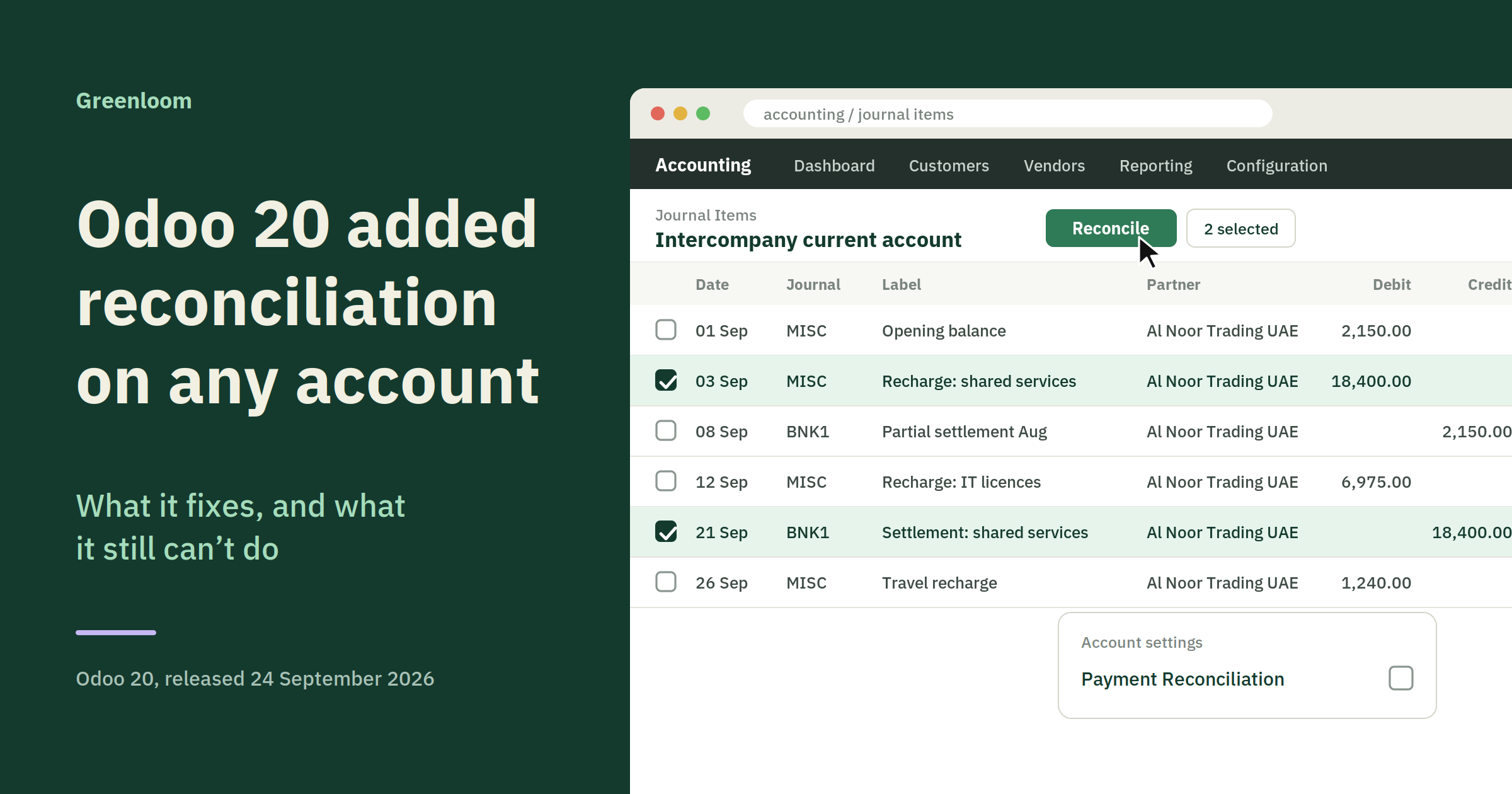
ERPs keep improving here. Odoo 20, for example, added reconciliation on any account, which we cover in what Odoo 20's change fixes and what it still can't do. But most teams still export to spreadsheets to handle processor and marketplace payouts.
The tools on the market sit in different places:
Category | Where the work sits | Best fit when |
Built-in ERP reconciliation (NetSuite, QuickBooks, Microsoft Dynamics, SAP, Oracle, Odoo) | Matches bank lines to items already in the ledger | Volume is low and most payments carry a clear reference |
Financial close platforms | The control workflow: proving balances are right and that the right people signed off | The pain is certification, sign-off and audit evidence across many accounts |
AI-native ERPs | Rebuild the general ledger itself; adopting one means replacing your ERP | You are replacing your ERP anyway |
Reconciliation layer, such as Greenloom | Runs alongside the ERP you already have and investigates the transactions that did not match | Net payouts, missing references and exceptions pile up every month |
Pick the category that matches where your team's hours actually go, not the one with the longest feature list.
Keep your ERP. Lose the exception pile.
Greenloom connects to your banks, Stripe, PayPal, Shopify and Amazon, matches every payout to your ERP daily, and sends your team only the exceptions to approve. No ERP changes. Try it free for 20 days on your own data. No card needed.
How do you choose reconciliation software?
The best way to choose reconciliation software is to test it on one month of your own messiest data, then ask every vendor, including us, these ten questions.
1. Does it work with the ERP I already run, or do I have to replace it? Know the switching cost before you fall for a feature.
2. Can it read my actual payment sources? Banks, Stripe, PayPal, Shopify Payments, Amazon, delivery apps, buy-now-pay-later providers. Uploaded files should work on day one.
3. What happens to the transactions that don't match? A tool that only matches the easy 80% leaves your team doing the hard 20% by hand.
4. Does it explain differences, or just flag them? Look for named reasons: this fee, this refund, this chargeback, this timing difference.
5. Does it guess? Ask what it does when there is no evidence for an explanation. The right answer is "it leaves it open for a person."
6. Can it match payments without a reference? Most customers never type the invoice number into a bank transfer.
7. Does anything post to my ledger without approval? It shouldn't.
8. Will my auditor be satisfied with the trail? You need to see what matched, what was held, the evidence, who approved it and when.
9. How fast is setup? Weeks, not quarters. Ask to see it on one month of your own data before you sign.
10. How is it priced? Per transaction, per seat or flat? Model it at your volume next year, not this year.
What are the best practices for financial reconciliation?
The teams that close fastest tend to share the same ten habits.
• Reconcile more often than monthly. Daily or weekly reconciliation of cash and payment accounts keeps month end from becoming a pile-up.
• Reconcile at the transaction level, not just the balance. A matching balance can hide offsetting errors.
• Pull the settlement file, not just the deposit. The payout report shows what is inside a net deposit: sales, fees, refunds and chargebacks.
• Check fees against your contract. Compare each deduction to the rate you agreed with your processor or marketplace.
• Set a written tolerance. Decide what size of difference is immaterial and document it, so nobody debates rounding every month.
• Give every exception an owner and an age. An exception with no owner becomes next quarter's write-off.
• Separate preparer and approver. The person who reconciles should not be the only person who signs off.
• Use clearing and suspense accounts carefully. Clear them every period. Money that sits in suspense is money nobody has explained.
• Keep the evidence with the reconciliation. Settlement reports, emails and approvals belong in one place, not across five inboxes.
• Automate the routine, keep humans on judgment. Let software match and investigate. Let people approve.
How does Greenloom help with financial reconciliation?
Greenloom is AI reconciliation software for finance teams. It works as a reconciliation layer alongside the ERP you already run. It matches your bank, payment gateway and marketplace payouts to your ERP every day, investigates the transactions that don't match, and sends your team only the exceptions that need a decision. It is used by 45 finance teams and was built on more than 2,400 real-world mismatches.
It works in three steps:
1. Connect. Banks, Stripe, PayPal, Shopify and Amazon. You can upload statements on day one. No ERP changes.
2. Match and investigate. Every transaction is matched to its invoice or payout, with the difference named: which fee took what, which refund was netted, which payout came in late or was split across two batches.
3. Approve and post. Your team clears a short queue. Only approved entries post to your ERP.
What Greenloom does
• Reconciles every day, across every transaction, not a sample.
• Breaks a short payout into its parts: processing fees, withholding tax, bank charges, FX movement and refunds.
• Flags a fee that is above the rate you agreed, or that isn't on your rate card.
• Matches payments with no reference, using customer, date and amount.
• Holds duplicates, late payouts and split payouts, and tells you why.
• Keeps a live audit trail of what matched, what was held, who approved it and when.
What Greenloom does not do
• It does not replace your ERP or your general ledger.
• It does not post a journal entry without a yes from your team.
• It does not assume a fee exists just because two amounts differ. No evidence, no explanation; the item stays open for a person.
• It does not replace your controller's judgment or your auditor's review. It gives both of them the working.
Is Greenloom a fit for your team?
Greenloom is built for finance teams that:
• take money through two or more processors, marketplaces or delivery platforms
• reconcile thousands of transactions a month, often across several brands or entities
• close in more than five days, with exceptions holding up sign-off
• still export payouts to spreadsheets to work out what is inside them
If you reconcile one bank account with a few hundred lines a month, your ERP's built-in tools are probably enough.Bring your worst month. We'll reconcile it live.
Book a 30-minute call. We load one month of your bank and payout statements, and you see what matches, what doesn't, and why. Then use Greenloom free for 20 days on your own data. No card needed, and we reply within one business day.
What do common reconciliation terms mean?
Term | Plain-English meaning |
Acquirer | The bank or company that processes card payments for a merchant and pays the money over. |
Audit trail | A record of what was done, when, on what evidence, and who approved it. |
Batching | Bundling many individual sales into one payout. |
Chargeback | A customer disputes a card payment and the money is reclaimed, often months later. |
Clearing account | A temporary account that holds money while it is in transit. |
Days to close | How many days the month-end close takes. |
Deterministic matching | Rules-based matching: if these fields agree, pair these records. |
ERP | Enterprise resource planning: the core system that holds the accounts, such as NetSuite, SAP or Microsoft Dynamics. |
Exception | An unmatched record that the evidence does not explain. It needs a person. |
General ledger (GL) | The master record of every financial transaction. |
Gross vs. net | Gross is the full amount before deductions. Net is what is left after them. |
Journal entry | A manual posting to the ledger to record or correct something. |
Merchant discount rate (MDR) | The percentage a payment provider keeps on each card transaction. |
Netting | Deducting one amount from another before paying, so one payment covers several things. |
Payout | The transfer a processor or marketplace makes to your bank, usually net and delayed. |
Settlement report | The provider's breakdown of what is inside a payout and what was deducted. |
Suspense account | Where money sits when nobody yet knows what it relates to. |
Tolerance band | A small difference the process is allowed to ignore as immaterial. |
Unapplied cash | Money received that hasn't been matched to an invoice or a source. |
Frequently asked questions about financial reconciliation
What is financial reconciliation in simple terms?
It is checking that two records of the same money agree. You compare your books with an outside record, such as a bank statement or a payment processor's payout report, match each entry, and explain every difference that remains.
What is the purpose of financial reconciliation?
To make sure your financial records are accurate and complete. Reconciliation confirms that reported revenue, cash and expenses reflect what really happened, catches errors and fraud early, and gives auditors the evidence they need.
How often should you reconcile your accounts?
At least monthly, as part of the month-end close. High-volume accounts, such as cash and payment processor accounts, are best reconciled daily or weekly, so that problems are caught while they are small.
What is the difference between bank reconciliation and financial reconciliation?
Bank reconciliation is one type of financial reconciliation. It compares the cash in your books with your bank statement. Financial reconciliation is the broader practice, and also covers payment processors, receivables, payables, credit cards, intercompany balances and the balance sheet.
What is payment reconciliation?
Payment reconciliation compares the sales you recorded with what a payment provider, such as Stripe, PayPal or Amazon, actually paid out after fees, commissions, refunds and chargebacks. It explains why a net deposit is smaller than the sales inside it.
What causes reconciliation discrepancies?
Five things: processing fees, timing differences between sale and settlement, netting of refunds and chargebacks, batching of many sales into one deposit, and genuine errors such as duplicates or wrong amounts. Only the last one is a real mistake.
Is financial reconciliation required by law in the US?
Public companies must maintain internal control over financial reporting under Section 404 of the Sarbanes-Oxley Act, and reconciliations are a core control. Private companies have no equivalent mandate, but auditors, lenders, investors and the IRS all expect accurate, supported records.
Can financial reconciliation be fully automated?
Matching can be largely automated, and AI can now investigate many mismatches too. Approval should stay with people. Auditors need to see that every figure traces to evidence and that a named person signed it off.
Can AI do account reconciliation?
Yes, for much of the work. AI can read settlement files, link deposits to the sales inside them and test whether a fee or refund explains a gap. It should leave unexplained differences open and never post entries without human approval.
Do I need to replace my ERP to automate reconciliation?
No. A reconciliation layer such as Greenloom runs alongside the ERP you already use. It pulls data from your banks and payment providers, investigates what doesn't match, and posts only approved entries back to your ERP.
About the author
Siddika Shaikh is CEO and Co-founder of Greenloom, AI reconciliation software that matches bank, gateway and marketplace payouts to a company's ERP every day and sends finance teams only the exceptions. More articles by Siddika
Sources
• Association for Financial Professionals, 2026 AFP Payments Fraud and Control Survey Report
• Ventana Research, Best Practices for a More Effective Close
• U.S. Securities and Exchange Commission, Sarbanes-Oxley Section 404: A Guide for Small Business
• U.S. Securities and Exchange Commission, Staff Statement on Management's Report on Internal Control Over Financial Reporting
• Stripe Docs, Balances and settlement time
• Stripe Docs, Payouts
• Stripe Docs, Payout reconciliation report
Updated

Comments
Join the conversation and share your thoughts with the community.
Community
Be the first to share your perspective.